
Outsourcing video production makes the most sense when a project carries real brand risk, is complex to produce, or has to make it through a long approval chain. Your in-house team is usually the better fit for fast, routine content, where knowing the subject and turning things around quickly matter most. Most B2B marketing teams that do video well use both, and what sets them apart is a clear way to decide which projects go where.
Budget is usually the first thing teams look at, and it should be part of the call. It just shouldn't be the only part. The decision matrix below adds two more filters, production complexity and brand risk, plus three tie-breakers for projects that sit right on the line. It's the same framework we use with finance and insurance marketing teams, followed by how compliance review, hybrid partnerships and AI change the math.
Prefer to watch? Brandon walks through the whole matrix in the video below.
What's the difference between in-house and agency video production?
An in-house video team is made up of people on your own payroll who make video for your company full time. A video production agency is an outside team you bring in for a project or an ongoing partnership, with its own crew, gear, editors and producers. The biggest differences come down to speed, range of skills, cost structure, and how much capacity you can call on when requests pile up.
In-house video team | Video production agency | |
|---|---|---|
Best at | Fast, routine content and anything that needs deep product knowledge | High-stakes, complex or large-scale productions |
Subject knowledge | Already knows your products, people and compliance team | Learns your brand over time, faster through an ongoing partnership |
Skills on hand | Often one or two people covering shooting, editing and motion graphics | A full crew, with a specialist for each role |
Capacity | Fixed, so extra requests wait in the queue | Scales up for big projects and back down after |
Cost structure | Fixed: salaries, benefits, gear and software, whether the work is steady or not | Variable: paid per project, or a set monthly amount through a partnership |
Outside perspective | Close to the brand, which can make fresh ideas harder to spot | Brings ideas from work with other companies and industries |
Neither column wins outright. Most in-house video people we meet are very good at their jobs and stretched across far more requests than one or two people can reasonably handle. That stretch is usually what starts the outsourcing conversation in the first place.
The decision matrix for outsourcing video production
The quickest way to decide whether to outsource a video is to plot it on two axes: production complexity (how hard it is to make) and brand risk (what's at stake if it falls flat). Each of the four quadrants points to a different answer.
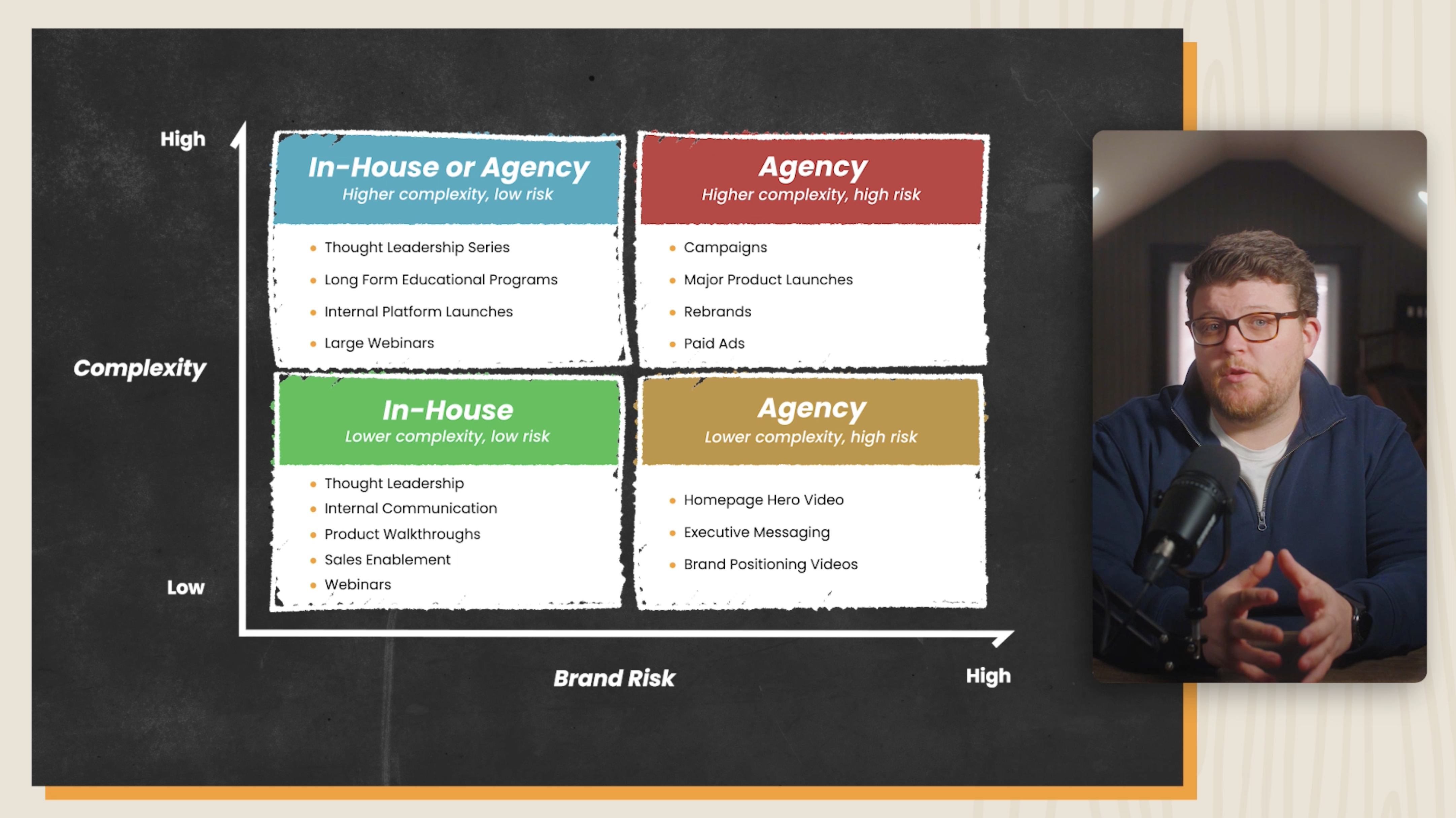
The point of the framework is to protect your internal team's time, so their effort goes to the work they do best and outside help goes where it adds the most.
Higher complexity, low risk
These projects look internal by default, but they aren't always simple. Think:
Multi-episode thought leadership series
Long-form educational programs
Internal platform launches
Large webinar programs
They're technically demanding, but not many people outside your company will see them. That's why they usually land with your in-house team, and in many cases that's the right call. The decision comes down to how experienced your team is and how much room they have. If you're not sure, ask your in-house video lead. In our experience, they're very candid about what their team can realistically take on.
If you do keep it internal, watch for a few things that tend to creep in over a long series:
Quality that slips from episode to episode
A team that gets stretched thin
Storytelling and pacing that lose consistency
A hybrid approach works well here. An outside partner builds the format, visual style and templates, then your team runs production day to day. Nobody has to reinvent the look of episode seven, and your team can put its energy into the content itself.
Lower complexity, high risk
This is the quadrant that catches the most teams. On paper these projects look simple, but the audience and the stakes say otherwise. Examples include:
Homepage hero videos
Executive messaging
Investor-facing content
Brand positioning videos
Production-wise, none of these are especially complicated. The risk sits in how they make your brand look, often in front of your most important audience.
Taylor Stavenjord leads brand at Equitable, where we made the Moments Matter campaign together. Here's how she sees it from the client side:
"Most video companies can get the big things right, but the big things don't make for a really great video. It's all the little small things, all those tiny details…"
Taylor Stavenjord, AVP, Brand Impact & Creative Services, Equitable
Your internal team can absolutely make these videos. What they often don't have, with a full queue of other requests, is the time to refine the messaging, pacing and stakeholder alignment to the level these pieces need. That's where outside support makes the biggest difference. In this quadrant, bringing in a partner is mostly about protecting how your brand is seen.
Higher complexity, high risk
This is the clearest call on the matrix. High complexity plus high visibility is where outsourcing video production pays off most. Think:
National campaigns
Product launches
Rebrands
Paid media campaigns at scale
These projects involve lots of stakeholders, bigger budgets and high expectations across channels. Internal teams aren't set up for that scale day to day, and they shouldn't have to be. Beyond the video itself, a production partner takes on:
Logistics, crews and locations
Versions across platforms and languages
Stakeholder feedback loops
Consistency across every deliverable
A single campaign can mean dozens or even hundreds of outputs, from bilingual cutdowns to platform-specific exports. Handing that off lets your team stay focused on whether the campaign actually works, while someone else keeps track of version 14 of the French 15-second cut.
Lower complexity, low risk
This is your in-house team's home turf: the day-to-day videos that keep your brand visible.
LinkedIn thought leadership clips
Internal communications
Product walkthroughs
Sales enablement videos
Smaller webinar recordings
These need speed, consistency and a level of subject knowledge that's hard for any agency to match, and that's exactly what internal teams are best at. Because the risk is lower, you can put volume and turnaround first without overthinking the production. This is also where most companies build momentum, since steady output here is what keeps you visible and trusted over time.
No in-house team? You can still keep this quadrant running with an ongoing partner, which we cover in the hybrid section below.
Three tie-breakers for projects on the line
Some projects will still sit right on the edge of the matrix. When that happens, run them through three more filters: how long the video needs to last, where it will live, and how many people have to sign off.
Tie-breaker | Lean in-house when | Lean on a partner when |
|---|---|---|
Longevity | It's short-term or timely content | It's an evergreen asset that needs to represent your brand for years |
Distribution | It's going out on organic channels | You're putting paid media budget behind it |
Stakeholders | The feedback loop is small | Several executives and a compliance review need to sign off |
The stakeholder filter tends to carry the most weight. With a long approval chain, an outside partner can act as a neutral project manager, keeping feedback organized and the project moving without putting your team in the middle of every disagreement.
How legal and compliance review changes the decision
If your videos go through legal or compliance, the review process should weigh heavily on whether you outsource, because it shapes the timeline as much as the shoot does. Most of our custom projects take 8 to 10 weeks, and a good share of that time is built in for review across your stakeholder layers.
Your in-house team has a real advantage here. They already know your products, your compliance people, and which phrases always come back with red ink. An outside partner that works with banks, insurers and wealth firms brings a different advantage: they plan for review from day one, so it doesn't surprise anyone the week before launch.
Whoever produces the video, these are the pieces that usually need a plan:
Legal and compliance review rounds, built into the schedule from the start
Claims, disclosures and wording that need sign-off
Captions and accessibility
French versions for Canadian audiences
Talent releases and consent from anyone on camera
Filming on secure or restricted sites
If several of those apply to a project and your team is already at capacity, that's a strong sign it belongs with a partner. If your team has handled them all before and the review chain is short, keeping it internal is usually fine.
Who owns the plan behind the video
Before you decide who makes a video, it helps to decide who owns the plan behind it: the goal, the audience, and how you'll know it worked. Some marketing teams have plenty of strategy and not enough people to carry it out. Others have production capacity but nobody with time to plan, so video turns into a queue of one-off requests.
Outsourcing can cover either gap. We start every project with your KPIs, your audience and the marketing result you're accountable for, and we plan each shoot so one production day can feed up to 90 days of content.
Agencies run into this too. Ryan Burgio co-founded Stryve Digital Marketing, a design and marketing agency we've partnered with on several video projects for their clients:
"A lot of times a client or an agency will not inherently understand what they want. There's a feeling that they're trying to get. And so a good video firm will help them to conceptualize it in a real way."
Ryan Burgio, Managing Partner and Co-Founder, Stryve Digital Marketing
If your team already owns the strategy, a partner can simply add hands. If nobody has time to own it, look for a partner that will help shape the plan as well as shoot it.
The hybrid model: an ongoing video partner
For most finance and insurance marketing teams, the answer ends up being both. An in-house team (or person) handles the day-to-day, and an outside partner is already lined up for the bigger, riskier work. The hybrid model works best when the partnership is set up ahead of time, so you're not scoping, briefing and approving a new vendor every time a high-stakes request lands.
An ongoing partnership usually gives you production days across the year and editing hours every month, with a team that learns your brand, stakeholders, approval process and priorities as it goes. It can back up an internal team when priorities pile up, or act as the video department for teams that don't have one.
That's how Acorn + Rumble, our video production partner model, works. As of October 2026, plans run on a 12-month term and start at $3,600 CAD/month, with production days and monthly editing hours built in. It's also how we currently work with Equitable.
Where AI fits in
As of 2026, AI tools make good video teams faster, in-house and agency alike, but they don't replace the judgment that decides what a video should say and how it should feel. We use AI daily for the invisible work, like cleaning up audio, matching colour between cameras and fixing small interview hiccups. It's made us about 10× more efficient than we were five years ago.
For this decision, that means AI won't necessarily make video cheaper, but it does make your budget go further, with more assets for the same spend at the same quality. If someone on your leadership team asks whether AI means you can skip both in-house and agency, the honest answer for anything your brand depends on is "not yet." (We might look back in five years and laugh at that.) There's more on this in our take on AI video production.
What outsourcing video production costs
Outsourcing turns video into a variable cost. You pay per project, or a set monthly amount through a partnership, and skip carrying salaries, benefits, gear and software year-round. As of October 2026, our one-off projects start at $15,000 CAD, most land between $40,000 and $70,000, and larger campaigns run $70,000 to $100,000+.
An in-house team costs more than its salaries. Gear, software, training and the projects that wait in the backlog while your team is busy all belong in the math. For a full breakdown of budgets and what drives them, see what B2B video actually costs.
Frequently asked questions
Is a video production retainer worth it?
A video production retainer is worth it when your team needs video steadily through the year. You get production and editing capacity on a set schedule, plus a team that already knows your brand and approval process, so each new request starts faster. Our Acorn + Rumble video production retainer works this way, with 12-month plans.
Can an agency work alongside our in-house video team?
Yes. An agency can take on the bigger productions while your internal team keeps the day-to-day content moving, or build formats and templates that your team then runs. Agreeing on who owns what at the start avoids overlap and keeps both teams on the work they're best at.
Will an agency understand our products and compliance rules?
Not as well as your internal team does on day one. A good partner closes that gap by learning your products, stakeholders and approval process over time. That's one of the main reasons an ongoing partnership tends to work better than starting fresh with a new vendor on every project.
Should we hire a videographer or outsource video production?
Hiring a videographer makes sense when you have steady, similar video work to keep one person busy year-round. If your needs swing between quiet months and big productions, or you need a full crew and specialists, outsourcing video production usually covers more ground for the money. Many teams end up doing both.
Where to go from here
If you've decided to outsource, our guide on how to choose a video production company covers what to look for and what to ask. And if you're weighing a new hire against an outside team, we're happy to talk it through, including when the honest answer is to keep it in-house.
 Book a call