
When every department adds a goal to the same video, it usually ends up doing none of them well. The fix is to pick one primary goal and one KPI before production starts, write it into your video creative brief, and get every stakeholder to sign off on it. That one decision protects the video's performance, your budget, and your credibility when results get reported up.
Want to skip ahead? Grab our free video creative brief template.
In B2B marketing at a large company, it's rare that a video only has one audience internally.
Product wants feature clarity.
Brand wants positioning.
Sales wants pipeline impact.
HR wants recruitment visibility.
Leadership wants something that reflects the company at a high level.
None of those requests are unreasonable. In fact, they're usually well-intentioned. The problem starts when all of them get layered into one video.
On finance and insurance marketing teams, where reporting is tight and every budget line gets a second look, this kind of layering quietly drags performance down. The video doesn't flop in some dramatic way. It just ends up with watered-down results that are hard to defend.
Why one video ends up with five goals
If you run marketing, you're usually doing two jobs at once:
Deliver results you can measure.
Keep everyone internally happy (or at least not annoyed with you).
When budgets are tight, it makes sense to want one video to pull extra weight. If it can check a few boxes at once, even better. (We get it. Most marketing teams we work with are already wearing five hats, and on a busy week, a couple of them are on fire.)
But a video isn't a multi-tool. It's closer to a scalpel: the clearer the job, the better it cuts.
A video made for awareness is structured differently than one made for lead generation.
A campaign built for engagement behaves differently than one built for recruitment.
A brand piece doesn't work the same way as something your sales team sends to prospects.
When those goals compete inside one narrative, something has to give. And usually, it's clarity.
The stakeholder trap in B2B video strategy
The stakeholder trap happens when:
Several departments each attach their own KPI to the same video
Nobody formally agrees on what success looks like
After launch, everyone judges the results by their own yardstick
From the outside, the video might look fine. It might even do okay. But without one clear KPI, there's nothing to measure it against. And when you can't tell what to fix, results flatline pretty fast.
This is especially risky on finance and insurance marketing teams, where results get reported up the chain. And when they're fuzzy, guess who's explaining them? Spoiler: it's usually marketing, and that's not a fun spot to be in.
Why multiple KPIs undermine performance
Every KPI changes how a video gets made:
Engagement rate: the hook, pacing, and story all need to be built around keeping people watching.
Qualified demo requests: the messaging and call to action need to walk viewers toward booking one.
Brand perception: tone and what makes you different come first, and the hard sell takes a back seat.
Try to do all three equally, and here's what happens:
The script gets crammed with competing messages.
The call to action gets wishy-washy.
Nobody's quite sure who the video is for.
Fixing it becomes guesswork.
Clear goals make better videos. Vague ones make forgettable ones. That's not a creative issue. It's a strategic one.
Choosing one KPI is a strategic safeguard
Committing to one KPI can feel a little uncomfortable at first, especially at a big company where everyone expects their priority to make the cut. But picking one KPI does three really useful things:
It makes creative decisions easier.
It makes stakeholder conversations simpler.
It protects your credibility.
When performance reporting is tied to a number everyone already agreed on, the results are much easier to defend. Instead of explaining why one video didn't boost engagement, drive leads, and help with recruiting all at once, you're reporting on one clear target.
The review meeting changes too. It stops being "I just don't love it" and becomes "did we hit the number?" And when results go up to leadership, that's a much better conversation to be having.
Put one KPI in your video creative brief
A strong video strategy doesn't eliminate stakeholder input. It structures it. Before production starts, here's the move:
Decide what the video's main job is.
Pick one KPI you can actually measure.
Get your key stakeholders to agree on it.
Write down what success looks like, and get it signed off.
The video creative brief is where all four of those live. It's the document everyone signs off on before a camera comes out, and the one you point back to when feedback starts drifting. It can feel slower upfront, but it saves you a lot of back-and-forth later.
When everyone knows what success looks like, the creative gets more focused, review rounds get shorter, and results conversations get a lot less awkward. And best of all, you're the one steering the project, not whoever has the most opinions in the review meeting. (The same thinking applies once you're in the edit, especially when it comes to how you show leadership the video.)
What goes in a video creative brief?
A video creative brief covers everything your team needs to agree on before production starts. The goals section matters most: one primary goal, with one or two metrics that measure it. A good brief includes:
The project objective and key messages
Goals and success metrics
Deliverables
Target audience
Tone, style, and creative references
Distribution and call to action
Timeline, and who signs off
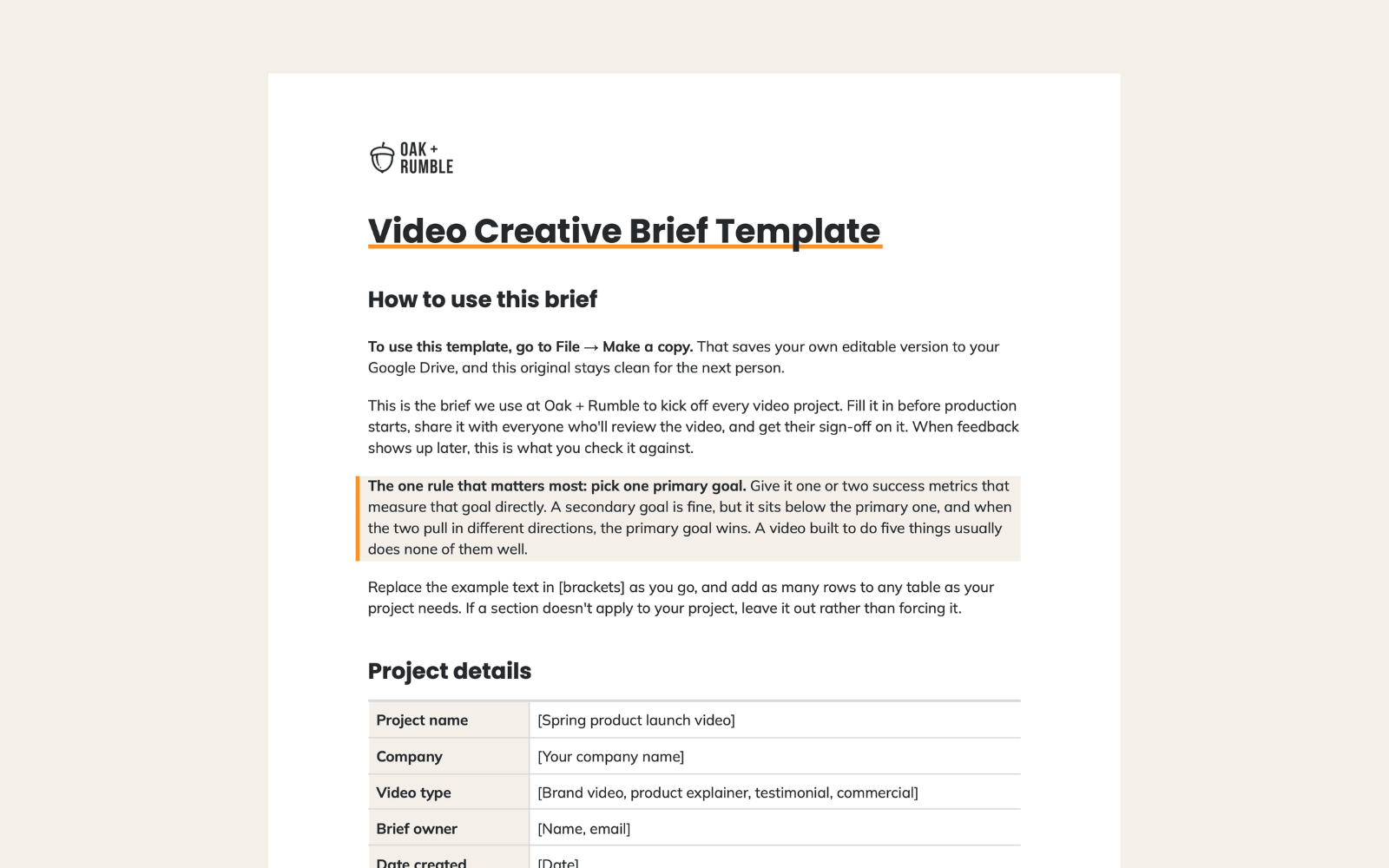
That's the structure we use to kick off every project at Oak + Rumble, and we've turned it into a template you can copy. A secondary goal is fine, as long as it sits below the primary one. When the two pull in different directions, the primary goal wins.
It also has a spot to list every reviewer up front, which is the easiest way we know to avoid a surprise approver showing up in the final week. (Every team has met one.)
Get the free video creative brief template (it opens a copy in Google Docs that's yours to edit).
Assess your current video strategy
If you're running video at a finance or insurance company and getting pulled in five directions, it might be time to step back and look at how your video strategy is set up. Our 3-Minute Video Benchmark Assessment gives you:
A video maturity score across strategy, production, and distribution
Insight into how your approach compares to others in your industry
A tailored plan outlining your most immediate growth opportunities
Take The 3-Minute Video Benchmark Assessment (free)
Still here? You’ve earned the full video transcript
As marketers, we all wear a lot of hats. And honestly, on most days, it feels like half of them are on fire. It's logical to want our videos to do the same. We think if we can pack in five different goals, we're being efficient with a tight budget. But when a video tries to wear every hat at once, it ends up looking just as burnt out and scattered as we feel. Trying to do everything usually achieves nothing.
At Oak + Rumble, we've spent 12 years navigating these stakeholder wishlists in enterprise finance and insurance. I've seen that the safest way to protect your reputation (and your budget) is to stop building "everything" tools. You don't need a video that does it all, you need a video that actually works.
We get it, you're trying to keep everyone happy while making sure your work looks good. This is the "Stakeholder Trap." It's a hard line to walk when you're balancing internal politics with your own professional standing.
The unfortunate reality is that when a video tries to please every department, the message gets so diluted that it's hard for anyone to win. It's frustrating because even though you were doing your best to accommodate everyone, you're often the one left answering for the lack of results.
To avoid that, the best move is to choose a lane. Choose one single KPI, like a specific engagement rate, and go hard after it.
When your video goal is clear, you aren't just benefiting the company, you're protecting yourself. You stop being the person caught in the middle of a wishlist war, and start being the one who delivered a specific, undeniable win you can take to your VP or CMO.
If you're feeling that "too many hats" pressure, take our 3-minute Video Benchmark Assessment. You'll discover how your video marketing plan stacks up against competitors in your industry, with a video maturity score across strategy, production, and distribution, and you'll also get a tailored plan that reveals your top growth opportunities.